Dirt Track Motorcycle Challenge
Reviews
Dirt Track Motorcycle Challenge targets players who enjoy methodical offroad racing rather than arcade speed. Its terrain physics reward reading the ground and managing momentum, while mission types like time trials and checkpoint runs give each track a clear purpose. The two control schemes and gradual difficulty curve make it approachable, though the simulation focus may frustrate those expecting instant arcade thrills. Best for riders who value precision over spectacle.
Description
Terrain Physics and Rider Response
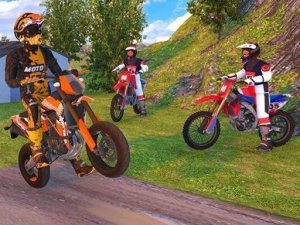
Every surface in Dirt Track Motorcycle Challenge changes how the bike behaves. Loose sand reduces traction, packed dirt offers more grip, and rocky paths introduce instability. The physics engine calculates weight distribution and momentum, so turns and slopes feel distinct rather than uniform. Success depends on reading the ground ahead and adjusting throttle and braking before the tires lose grip. [IMG_1]
Course Environments and Visual Feedback
Courses are set in varied natural locations. Open desert stretches allow higher speeds but demand careful line selection to avoid soft patches. Forest sections introduce tighter paths, more obstacles, and elevation changes. The 3D graphics present these areas with clear detail, helping players spot dips and rises. Sound effects match the environment, from engine echoes in open areas to tire noise on different surfaces. [IMG_2]
Mission Objectives and Track Purpose
Each run presents specific goals beyond simply reaching the finish. Time trials push players to find the fastest route. Checkpoint challenges require consistent control to hit markers within a limit. Some objectives ask for controlled maneuvers, such as maintaining a certain speed or avoiding spills. This structure gives each track a clear purpose and rewards careful planning rather than constant full-throttle riding.
Control Options and Difficulty Curve
The game offers two input methods: touch-based controls and tilt steering. Both are designed to feel responsive without requiring complex inputs. Beginners can start with simpler tracks that have wider paths and fewer sharp turns. The learning curve gradually introduces tighter corners and steeper slopes. Mastering the controls involves practicing throttle management and brake timing to keep the bike stable through rough sections.








Editorial Notes