Friendship Puzzle Jigsaw Game
Reviews
Friendship Puzzle Jigsaw Game delivers exactly what its name suggests: a gentle jigsaw experience built around warm images of friendship. The three difficulty levels give it flexibility, letting you choose a quick easy puzzle or a longer hard one without changing games. The lack of a timer is its strongest design choice, making it welcoming for children and anyone who finds timed puzzles stressful. The main limitation is variety: 12 images is a modest set, and there is no scoring, multiplayer, or progression beyond completing each picture. Players who want competition or constant novelty may lose interest, but those seeking a quiet, family-friendly puzzle will find it fits that purpose well.
Description
What You Solve
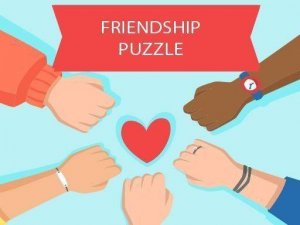
Friendship Puzzle Jigsaw Game contains 12 distinct images, each showing a moment of connection between friends. The artwork is the game's focus: warm, gentle scenes that make the puzzle feel personal rather than abstract. You select any of the 12 graphics before starting, so you can pick a picture that appeals to you rather than working through a fixed order.
Choosing Your Challenge
Every image can be played at easy, medium, or hard difficulty. Easy suits a short break, medium sits in the middle, and hard demands more patience and attention. The difficulty affects how demanding the assembly is, not the picture itself. You can switch difficulty between puzzles, so a quick session and a longer one can coexist in the same game.
How a Puzzle Plays Out
Once you start, the pieces appear scattered on the screen. Your job is to drag each piece into its correct spot on the board. The interface responds smoothly, which matters in a jigsaw game because constant dragging makes clumsy controls frustrating. There is no timer and no penalty for slow progress. You finish when the image is complete, then move on to another graphic or difficulty.
Who It Suits
The content is family-friendly with no violence or inappropriate themes, so it works for children and adults alike. Players who dislike time pressure will find the absence of a clock the main draw. Those who want competitive scoring or online opponents will not find that here; the game is built around solitary, unhurried solving.








Editorial Notes