Notebook Tank Duel Arcade
Reviews
Notebook Tank Duel Arcade trades realistic war imagery for hand-drawn notebook graphics and original sound effects, keeping the tone playful. Its five-round hit-based scoring keeps matches short and readable, while separate movement and shooting controls add a layer of positioning skill. The mix of single-player, local two-player, and online modes gives it flexibility for solo or social play. The main limitation is scope: it is a focused arcade duel rather than a deep tactical game, which suits players wanting quick, accessible sessions.
Description
Notebook-Style Tank Combat
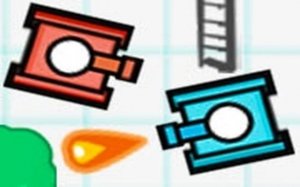
Notebook Tank Duel Arcade sets tank duels on a page that looks hand-drawn in a notebook. The visual choice gives every match a retro, sketch-like feel rather than a realistic war setting. Original sound effects accompany the action, reinforcing the lighthearted tone. The goal is simple: hit the opposing tank more often than you get hit. Each match runs for five rounds, and the player with the most hits when the rounds end wins. That short format makes every duel easy to finish in one sitting.
[IMG_1]
Modes and Match Flow
Three ways to play are available. Single-player mode pits you against a computer-controlled tank. Two-player mode lets two people share one device for a local duel. Online multiplayer matches you against other players. Across all modes, the structure stays the same: five rounds, score by hits, highest total wins. Different maps appear during play, so the space you fight in changes between matches. Obstacles on those maps matter because they block shots and give you a place to hide while you line up your next attempt.
[IMG_2]
Controls and Input Layout
Controls differ by mode. In single-player, the arrow keys move your tank and the spacebar fires. In two-player, Player 1 moves with W, A, S, and D and shoots with F, while Player 2 uses the arrow keys to move and M to shoot. Online matches follow the same single-player key layout. The scheme is quick to pick up, but aiming and dodging at the same time is where the challenge sits. Movement and shooting are separate actions, so positioning before you fire matters as much as the shot itself.
[IMG_3]
Reading the Battlefield
Because each map has its own layout, learning where cover sits helps you survive longer. Use obstacles to break an opponent's line of sight, then move out to take your shot. In multiplayer, watching how your opponent moves reveals patterns you can predict. Patience tends to beat rushing, since a wild shot rarely lands. Regular play sharpens reflexes and helps you judge when to advance and when to hold position.







Editorial Notes