Phrase Master Word Puzzle
Reviews
Phrase Master Word Puzzle stands out for its restrained design: no timer, no clutter, just scrambled words and a color-coded hint system that makes every guess informative. The five-attempt limit adds gentle pressure without becoming punishing, and the progressive difficulty keeps longer phrases from feeling arbitrary. Its strongest asset is the curated pool of proverbs and sayings, which gives the game educational value without turning it into a quiz. The main limitation is that players seeking fast-paced or competitive word challenges may find the pace too slow.
Description
Unscrambling Phrases with Color-Coded Clues
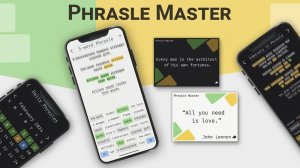
Each round in Phrase Master Word Puzzle presents a set of shuffled words on screen. Your job is to tap them into an order that forms a complete proverb, idiom, or familiar saying. After you submit a guess, every word receives a color: green means it belongs in that exact spot, yellow means it belongs somewhere else in the phrase, and gray means it is not part of the answer at all. This three-state feedback turns each attempt into a process of elimination rather than blind guessing.
Five Attempts and a Widening Vocabulary
You have up to five tries to solve a puzzle. That limit encourages deliberate choices instead of rapid tapping, and the color clues from earlier guesses narrow the possibilities for later ones. As you advance, the phrases grow longer and more complex, so the reasoning required shifts from simple word placement to recognizing common sentence structures and idiomatic patterns. The game draws from a broad collection of proverbs and sayings, which keeps repetition low and exposes players to language they may not have encountered before.
Designed for Relaxed, Self-Paced Play
There is no timer and no penalty for thinking. The tap-to-select interface works on any device, and the clean layout keeps attention on the words themselves. Because the content is curated to suit all ages and backgrounds, the game functions as both a casual pastime and a light educational tool. It can be played offline, making it practical for travel or areas with unreliable internet access.
Approaching a Puzzle Strategically
Experienced word players often start by placing short, common words such as "the" or "and" and watching how the colors shift. Treating each gray word as a confirmed exclusion and each yellow word as a movable piece reduces the search space quickly. Regular play builds pattern recognition for how sayings are typically structured, which in turn makes longer phrases less intimidating.








Editorial Notes