Hue Arrange Puzzle: Logical Thinking
Reviews
Hue Arrange Puzzle: Logical Thinking delivers a focused sorting challenge with a clean interface and no time pressure. The pouring rule—only onto empty containers or matching colors—creates genuine strategic depth, while the gradual introduction of new hues keeps the difficulty curve approachable. It suits players who enjoy methodical problem solving and short mental breaks. The main limitation is that the core loop stays consistent throughout, so those seeking varied game modes may find it repetitive.
Description
Pouring Rules and Core Objective
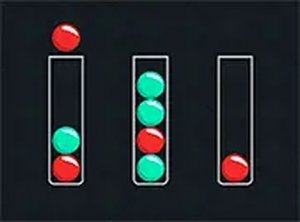
The goal in Hue Arrange Puzzle: Logical Thinking is straightforward: rearrange colored liquids so that every container ends up holding only one shade. The pouring rule is what creates the challenge. A liquid can be poured only onto an empty container or onto a liquid of the same color. That single restriction turns each move into a commitment. A pour that looks harmless early on can leave a color stranded with no valid destination, forcing you to rethink the entire sequence. [IMG_1]
How the Difficulty Curve Works
The game opens with three colors and three containers, which is enough to teach the basic flow without overwhelming you. From there, additional hues and vessels appear gradually. Later arrangements often have no obvious first move, so you have to create intermediate steps by using empty containers as temporary buffers. The game never imposes a timer, which means you can study a layout for as long as you need before committing to a pour.
Interface and Cross-Device Play
The interface stays out of the way. Containers are clearly marked, liquids use distinct hues, and tap or click controls respond immediately. There are no complex menus or lengthy animations to sit through. The game runs in modern desktop and mobile browsers and adapts to different screen sizes without losing clarity, so you can play in short breaks or longer sessions. [IMG_2]
Pattern Recognition and Hint System
Progress depends more on patience than speed. You learn to spot which colors can be isolated first and which containers should be kept free for later steps. When you get stuck, a hint system offers guidance without revealing the full solution. That design keeps the satisfaction of solving each arrangement yourself while preventing frustration from blocking your progress entirely.








Editorial Notes